Once I started telling people that I was planning to walk from Canterbury to Rome I noticed that even though the overall reactions varied, there were a number of recurring questions. I try my best here to answer what has come up in conversations. Feel free to ask more, and I’ll post here with a response when I can.
What exactly is the Via Francigena?
Here is the general route:
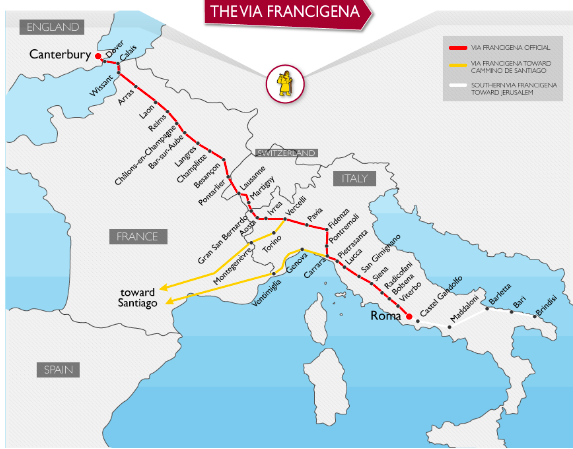
Additional resources:
Confraternity of Pilgrims to Rome
Wikipedia entry on Via Francigena
If you’re curious, check out Efren Gonzales’ 1 minute videos he filmed with a drone while he walked. His is my favorite of all the pilgrim accounts I’ve encountered.
How many miles is it?
It’s roughly 1,200 miles (1900 km, give or take, based on the Lightfoot guide). The original path was 1800km, but that specific route is now on a number of present-day highways, hence the updated guides. My map and route documents are in kilometers, so I’ll likely favor km in my journal, but I’ll try to post both.
Why are you doing this?
Short answer: The opportunity to do this became a logistical possibility, and I couldn’t pass it up.
Longer answer: The ‘how’ will have been the ‘why.’ Apparently, it’s generally understood that the results of a pilgrimage are not felt until one returns home from the trip, and that makes perfect sense to me. There is a sub-genre of contemporary travel memoirs where people go off on a grand search for something (meaning, purpose, distraction, solace, etc.) or are trying to run away from something (some variation of loss: heartbreak, death.) In 20 years of travel in 20 countries, I have done versions of both. However, this trip doesn’t seem to be about either of those motivations. If anything, it feels more like an exercise in experiencing the present.
How long will the walk take you?
It seems to take most people between 85 and 100 days. As far as I know there aren’t people who care about speed records for this trail because, I assume, it defeats the spirit of a pilgrimage (?). It seems I’m starting a little earlier than some do because of a couple scheduling issues (that really wouldn’t be that interesting to detail here), and so I thought I’d take my time with it and spend extra days in places when I can (for example, I’ll celebrate my birthday on the trip, so I’ll take a couple extra days then). Also, there are a ton of people who do this in stages. In fact, one couple of women I’ve been in my research are taking one week a year for the next ten years to do it. Though the whole route is the Via Francigena, to my understanding, the Vatican will only give Testimoniums to people who complete the last 100 km to Rome on foot or the last 250 km on bicycle or horseback (documented in the passport). I’ve seen varying distances of this, though.
How are you paying for this?
Though this is a fraught question, I appreciate that many people are genuinely curious for their own planning. However because everyone has different circumstances and different priorities, I’m not sure how helpful this will be because these resources are unique to me.
- I will be fulfilling (and compensated for) professional responsibilities during a significant chunk of my walk. (Actually, I’ll also be fulfilling professional responsibilities that I won’t be compensated for because I work in the American higher education system, which runs on exploited labor and the fumes of desperation and hope).
- I have a humble, yet serviceable savings that I maintain by living below my means for the express purpose of doing things like this.
- I’ve received a modest gift from an organization I worked with while doing research for my PhD.
- As a pilgrim with credentials, sometimes I’ll have discounted accommodations and meals available to me.
- Ms mom gave me an early birthday present that I’ll be using for something special tbd along the way.
- Note, Some people ask for donations to fund their trip. I don’t feel comfortable doing that. I’m not casting judgement on those who do; in fact, in some cases it makes perfect sense. I don’t think it would be appropriate for me to do that for a handful of reasons. If you are curious about how others funded their trip, please look at other pilgrim blogs on the internet and see what others do (I’ll try to post links to a bunch I’ve read when I get a chance. I’ll put a link here when I do). But, again, each person’s trip is different.
Are you going alone? (and aren’t you worried about safety?)
The original plan was to go alone, though we’ve been able to negotiate M joining me in Besançon (flying into Paris and taking the train in) so he can walk through Switzerland with me (he’ll fly out of Turin after spending my birthday with me in Ivrea). It really couldn’t have worked out better. So, I’ll do Canterbury to Besançon alone, Besançon to Ivrea with M, and Ivrea to Rome alone.
I plan on taking appropriate safety precautions. Nothing is guaranteed, but I’m being completely sensible. I’m not going to not do something because I’m a woman.
How heavy is your pack?
I did an initial run-through with everything I wanted, and the base weight (without water or food) of my pack was around 20 pounds, but water is heavy. As I write this, it’s about a week before I fly to London. I’d like to trim that down to 12-15 because I drink a lot of water when I’m not hiking so I’d like the wiggle room to carry a decent amount.
Update: see Day 1 post about weight surprises/issues.
What are you packing? What specific brands/items do you recommend?
- two pair of hiking shoes (Solomon brand and Oboz brand) 1 pair of rugged-style mary janes for rest days in town (Naot brand)
- Macbook Air (for professional responsibilities I’m keeping up with while on the trip).
- 3 pairs of hiking leggings (2 underarmour brand-one crop and one capri, 1 tasc brand-full length)
- 2 sports bras (shefit brand–they are somewhat expensive, but they. are. the. most. comfortable. sports. bras. I’ve. ever. owned.).
- 4 pair hiking socks (Darn Tough brand)
- two long-sleeve hiking shirts (both tasc brand)
- one short-sleeved hiking shirts (tasc brand ‘nola,’)
- 1 moisture-wicking, lightweight fleece jacket for chilly mornings & evenings and the Alps
- 3 hiking skirts (Columbia Brand). I like the extra coverage over the leggings and it give me more privacy when I pee. 🙂
- buff (Devold brand)
- Ultra-light gore-tex rain jacket (REI Co-op Drypoint GTX)
- iphone 7
- chargers for laptop and phone
- personal care items (shampoo, conditioner, face and body wash, deodorant, moisturizer, sunscreen, toothbrush, toothpaste, mini packets of laundry soap, diva cup, vitamins, a needle and thread)
- security (pepper spray, switch blade, a corded lock to secure my pack when I’m not wearing it)
- first aid (bug spray, after bite cream, antispetic, band-aids, compeed pads, ibuprofen)
- hiking poles
- Swiss army knife
- an ultra-light bug-resistant sleeping bag liner (Sea to Summit brand) (I’ve since removed this in Canterbury for weigh issues)
- hiking umbrella (I’m on the fence about this, but many people recommended it, so I’m giving it a shot. It might be the first thing to go.)
- Assorted items (sunglasses, bank cards, passport, pilgrim passport, VF routes, gum, mints, earphones, safety pins, a collapsable sun visor).
I’ll update what I actually end up taking once the contents settle down in the first week of travel.
Isn’t there water between England and France?
NO JOKE, I’ve been asked this 6 times. By smart people.
I’m taking a ferry from Dover to Calais…just like Sigeric did. 🙂 (well, he took one from Dover to Wissant, but P&O goes to Calais nowadays 🙂
I received a question about toiletries, and how I manage to keep pack weight down while still carrying everything I need.
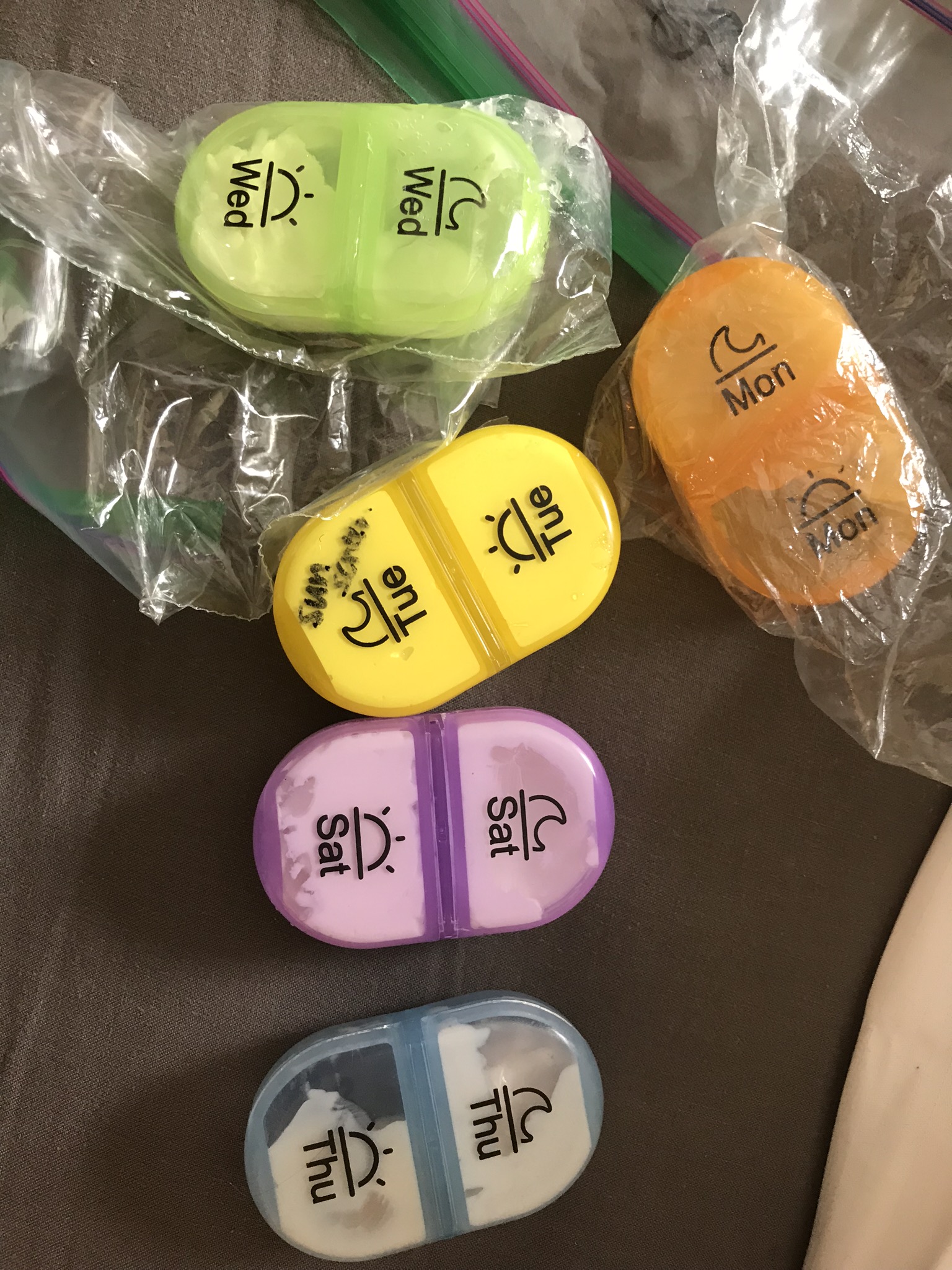
I use these small ‘waterproof’ lightweight pill cases to carry what I need while cutting down on the weight of large packaging.
- blue: face moisturizer
- purple: deodorant I crammed into the space and then use my finger to apply (that saved me a bunch of weight–deodorant applicators are bulky.
- yellow: sunscreen
- orange: Neosporen in one side and tiger balm in the other
- green: NOK cream and and a cooling gel for feet.
I also have one travel container of shampoo (which doubles as body gel) and one travel container of conditioner which I add to when I’m at a lodging that offers those things. My travel toothpaste has the floss wrapped around it and I just use my Swiss army knife to cut it off.
 Canterbury to Rome